

Is the NEBOSH General Certificate Worth It?
Career Guide | BV Safety Academy
What difference could it make to your career over the next five, ten or even twenty years?
By Dean Ferguson, CEO & Head of Learning Partner, BV Associates Limited

Introduction
One of the questions I’ve been asked countless times over the last twenty years is whether the NEBOSH National General Certificate is really worth the investment. It’s an understandable question, and one that deserves more than a simple yes or no answer.
Choosing to study for a professional qualification is a significant decision. It requires an investment of time, commitment and money, often alongside the demands of work and family life. Before making that commitment, it’s only natural to ask whether it will genuinely make a difference to your career.
Over the years, I’ve watched thousands of learners complete the General Certificate, each arriving with their own ambitions and motivations. Some wanted to move into dedicated health and safety roles, while others were looking to strengthen their leadership skills or improve their prospects within their current organisation. Many simply wanted greater confidence in their ability to manage health and safety effectively.
Although their goals were different, they all had one thing in common. They wanted to invest in themselves.
That’s why I believe the question isn’t simply whether the NEBOSH General Certificate is worth it. A better question is to ask what value it could add to your career over the next five, ten or even twenty years.
Professional qualifications should never be viewed purely in terms of the certificate you receive at the end of the course. Their real value lies in the knowledge you gain, the confidence you develop and the opportunities they help create. A recognised qualification can open doors, but it also changes the way you think, the decisions you make and the conversations you’re able to have within your organisation.
Throughout this guide, I’d like to share the perspective I’ve gained from teaching the General Certificate for more than two decades. We’ll look beyond pass rates and course content to explore why employers continue to value the qualification, who benefits most from studying it and, perhaps most importantly, how it can influence the direction of your career long after the course has finished.
Only then can we answer the original question with the context it deserves.
What Does “Worth It” Really Mean?

When people ask whether the NEBOSH General Certificate is worth it, they’re often thinking about one thing.
Will it help me get a better job?
There’s nothing wrong with asking that question. Career progression is one of the main reasons people choose to study, and it’s perfectly reasonable to want to know whether a qualification will improve your prospects. However, after more than twenty years of working with learners from every imaginable background, I’ve come to believe that it’s only part of the picture.
The real value of the General Certificate isn’t measured solely by the job you secure afterwards or the salary attached to it. Those things may well happen, but they’re often the result of something much more important.
The qualification changes the way you think.
It helps you understand why accidents happen rather than simply how to respond to them. It gives you the confidence to ask better questions, challenge unsafe practices when necessary and contribute more effectively to discussions about risk, leadership and organisational performance. Those are qualities that employers notice because they’re qualities that make a positive difference in the workplace.
I’ve seen learners return months or even years after completing the course to tell me about promotions, new responsibilities or career changes. Interestingly, many don’t begin by talking about the qualification itself. They talk about feeling more confident in meetings, being asked to lead projects, or finding that colleagues now seek their advice on health and safety matters.
That confidence doesn’t come from receiving a certificate.
It comes from understanding the subject well enough to apply it in real situations.
For me, that’s where the true return on investment lies. The General Certificate provides knowledge, but knowledge on its own has limited value. When that knowledge is combined with your existing experience, professional judgement and a willingness to keep learning, it becomes something far more powerful.
It becomes competence.
And competence is something that stays with you throughout your career.
A qualification may help you secure your next opportunity, but the confidence and capability you develop while earning it will continue to influence every opportunity that follows. That’s why I encourage learners to think beyond the immediate outcome and consider the long-term impact that investing in themselves can have.
When viewed over the course of a professional career rather than a single job application, the question changes completely.
It is no longer simply, “Is the NEBOSH General Certificate worth it?”
Instead, it becomes, “Can I afford to miss the opportunity to develop the knowledge, confidence and credibility that could influence my career for years to come?”
Why Employers Continue to Value the NEBOSH General Certificate

If the NEBOSH National General Certificate has been around for many years, why does it continue to appear on so many job descriptions?
The answer is surprisingly simple.
Employers aren’t looking for certificates. They’re looking for capable people.
Every organisation, regardless of its size or industry, has a legal and moral responsibility to protect the health, safety and wellbeing of its employees. At the same time, businesses need to remain productive, profitable and resilient. Achieving that balance requires people who can make informed decisions, recognise risk before it develops into an incident and influence others to work safely.
That’s exactly where the General Certificate adds value.
It provides a structured understanding of health and safety management, but more importantly, it encourages learners to think differently about the workplace. Rather than seeing health and safety as a collection of rules and procedures, they begin to understand how good health and safety supports every part of an organisation. Fewer incidents, better planning, stronger leadership and a more positive culture all contribute to better business performance.
Over the years, I’ve spoken to many employers who have recruited learners after completing the General Certificate. Interestingly, they rarely tell me they recruited someone simply because they held a NEBOSH qualification.
Instead, they talk about the confidence that qualification gives them.
It tells them that the individual has invested in their own professional development. It demonstrates a willingness to learn, an understanding of recognised health and safety principles and a commitment to improving both themselves and the organisations they work for.
Of course, a qualification on its own doesn’t make someone an outstanding employee. Experience, attitude, communication skills and the ability to work with others remain just as important. However, when those qualities are supported by a recognised qualification, employers gain additional confidence that they’re recruiting someone who is serious about their profession.
This is why I often describe the General Certificate as a qualification that validates experience rather than replacing it.
Someone with years of practical knowledge gains the opportunity to demonstrate that knowledge through a recognised framework. Equally, someone earlier in their career gains the confidence and understanding to contribute more effectively while continuing to build practical experience.
In both cases, the qualification becomes far more than a certificate.
It becomes evidence of professional commitment.
That’s one of the reasons the General Certificate has maintained its reputation for so many years. Industries evolve, legislation changes and workplaces become more complex, yet organisations continue to need people who can think critically, manage risk sensibly and help create environments where people can perform at their best.
Those qualities never go out of date.
And neither does the value of developing them.
Who Benefits Most from the NEBOSH General Certificate?
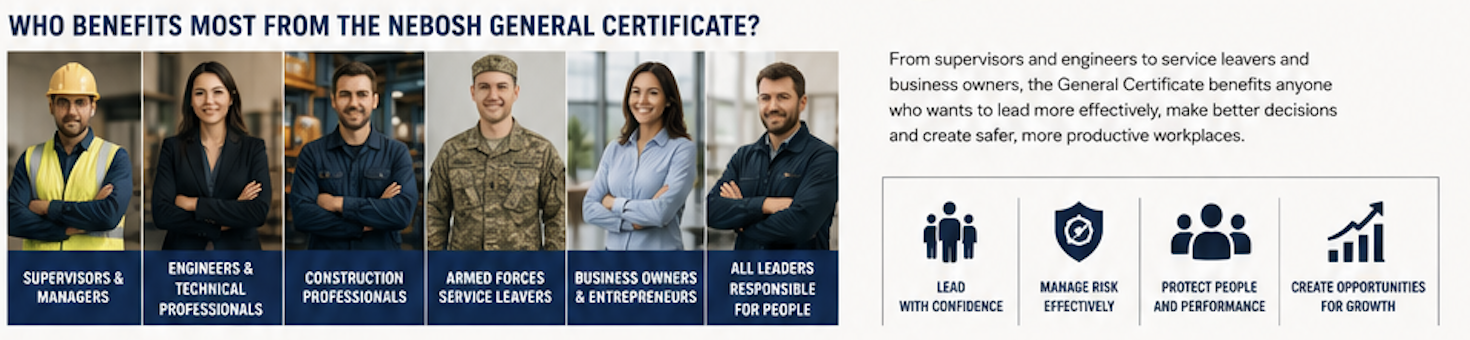
One of the reasons the NEBOSH National General Certificate has remained so highly regarded is because it isn’t designed for one specific profession or industry. Although many people associate it with health and safety advisors, the reality is that the qualification benefits a much wider audience.
Throughout my career, I’ve taught people from almost every sector imaginable. Construction managers, engineers, production supervisors, warehouse managers, local authority officers, facilities managers, service leavers, business owners and people taking their very first steps into health and safety have all sat in the same classroom. Despite their different backgrounds, they quickly discover that the principles of good health and safety are universal.
For supervisors and managers, the qualification provides confidence. Managing people carries responsibility, and understanding how to identify hazards, assess risks and make sensible decisions allows leaders to create safer, more productive workplaces. Many learners tell me that after completing the course they approach conversations with their teams differently because they understand not just what needs to be done, but why.
For engineers and technical professionals, the General Certificate complements the expertise they already possess. Engineers are natural problem solvers, and health and safety is fundamentally about solving problems before they result in harm. Understanding how technical decisions influence people, processes and organisational risk makes them even more effective in their roles.
Construction professionals have always recognised the importance of health and safety, but today’s projects demand more than compliance. Site Managers, Contracts Managers and Project Managers are expected to demonstrate leadership, influence contractors, manage changing risks and deliver projects safely while maintaining programme and quality. The General Certificate helps build the knowledge and confidence needed to achieve that balance.
One group I particularly enjoy working with is Armed Forces service leavers. Having made that transition myself, I understand both the opportunities and the uncertainties that come with moving into civilian employment. Service personnel often underestimate just how transferable their experience is. Leadership, planning, communication, teamwork and risk management are all qualities employers value. The General Certificate helps translate those strengths into a qualification that civilian employers immediately recognise.
Perhaps the biggest surprise for many people is that some of our most successful learners never intend to become full-time health and safety professionals at all. They study because they want to become better leaders, stronger managers or more effective decision-makers. They recognise that health and safety isn’t a separate function within a business; it’s an integral part of good management.
That’s why I believe the General Certificate has such broad appeal. It doesn’t prepare you for a single job. It prepares you to make better decisions, protect people more effectively and contribute more positively to whichever organisation you’re part of.
In the end, that’s why so many different people continue to study it. They aren’t all pursuing the same career, but they are all investing in becoming better professionals.
The Return on Investment
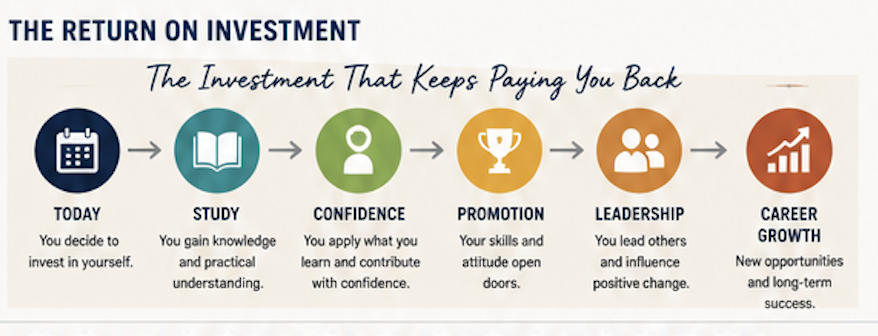
Whenever someone asks me whether the NEBOSH General Certificate is worth the investment, I always encourage them to think beyond the course fee.
Most of us have no hesitation investing in a new phone, a car or improving our homes because we can immediately see the benefit. Investing in ourselves can sometimes feel different because the return isn’t always instant or easy to measure. Yet, in my experience, it’s often the investment that delivers the greatest long-term rewards.
Of course, there can be financial benefits. A recognised qualification may help you secure a promotion, move into a new role or strengthen your position when applying for opportunities with a new employer. However, I’ve never believed that salary alone defines the value of professional development.
The biggest change I see in learners is confidence.
At the beginning of a course, it’s common for people to question themselves. They worry about whether they’ll understand the content, whether they’re experienced enough or whether they’ve made the right decision by enrolling. By the end of the programme, those same people are contributing to discussions, analysing workplace scenarios and explaining how they would approach real health and safety challenges.
That transformation is difficult to measure, but it’s impossible to ignore.
Confidence changes the way people communicate. It encourages them to contribute during meetings, challenge unsafe practices when necessary and take on responsibilities they may previously have avoided. Over time, those changes often lead to greater professional recognition because employers notice people who are willing to think critically and take ownership.
The General Certificate also provides something that many people overlook: credibility.
When you’re discussing health and safety with colleagues, contractors or senior leaders, having a recognised qualification behind you gives weight to your opinions. It demonstrates that your recommendations are supported by structured learning and recognised professional standards rather than personal opinion alone.
Perhaps the greatest return, however, is something far less tangible.
It’s the way you begin to look at the world around you.
Once you’ve developed a deeper understanding of health and safety management, you naturally start recognising risks, questioning unsafe behaviours and thinking more proactively about protecting people. Those habits don’t disappear when the course finishes. They become part of the way you work, the way you lead and, in many cases, the way you live.
I’ve often had former learners tell me they now notice things they would never have considered before. They approach projects differently, involve people earlier in decision-making and think more carefully about the consequences of seemingly small decisions. That’s not because they’ve memorised legislation. It’s because they’ve developed a different mindset.
When you look at the General Certificate through that perspective, the question is no longer whether it’s worth the investment.
The better question is this:
What value could a stronger understanding of health and safety bring to every role you undertake for the rest of your career?
For me, that’s where the real return on investment lies. Not in the certificate itself, but in the knowledge, confidence and professional judgement that continue to benefit you long after the course has ended.
Common Misconceptions About the NEBOSH General Certificate
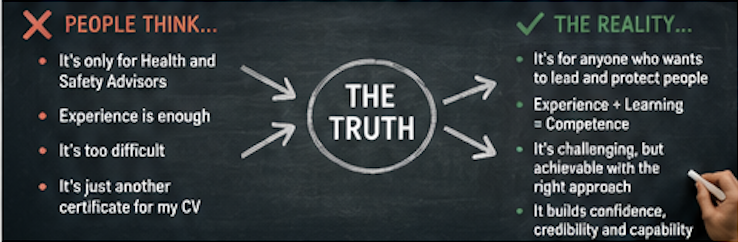
Over the years I’ve heard just about every reason why someone thinks the NEBOSH General Certificate isn’t for them. Some people worry they’re not experienced enough, while others convince themselves they’re too experienced to benefit from studying. Interestingly, both groups often reach exactly the same conclusion once the course has finished—they wish they’d done it sooner.
One of the most common misconceptions is that the General Certificate is only relevant if you want to become a Health and Safety Advisor.
I understand why people think that. The qualification is widely recognised within the profession, so it’s easy to assume it’s designed exclusively for those pursuing a dedicated health and safety career. In reality, that’s only part of the story.
The majority of people I meet don’t intend to change careers at all. They want to become better supervisors, stronger managers, more effective engineers or more confident business owners. They recognise that every leadership role carries responsibility for the wellbeing of others, and they want the knowledge to fulfil that responsibility effectively.
Another misconception is that experience alone is enough.
Experience is incredibly valuable, and throughout my career I’ve always said that qualifications should never replace it. However, experience and professional development are not competing ideas—they complement each other. Experience teaches you what has happened in the past, while structured learning helps you understand why it happened and how similar situations can be prevented in the future.
When those two things come together, they create competence.
I also hear people say they’re worried the course will be too difficult.
My response is always the same.
The General Certificate is designed to challenge your thinking, not to catch you out. Learners come from a wide variety of educational backgrounds and industries, and success isn’t determined by how much you can memorise. It’s determined by your willingness to engage with the subject, understand the principles and apply them to realistic workplace situations.
That’s one of the reasons I encourage learners to relax and enjoy the learning process. You don’t need to remember every detail because, in the real world, health and safety professionals don’t rely on memory alone. They investigate, consult colleagues, refer to guidance and make informed decisions based on the information available. The qualification reflects that reality far more closely than many people realise.
Finally, there’s the misconception that the General Certificate is simply another certificate to add to your CV.
If that’s all it becomes, you’ve missed the greatest benefit.
The real value isn’t the qualification itself.
It’s the confidence to ask better questions, the judgement to make better decisions and the ability to influence others to work more safely. Those are qualities that stay with you long after the certificate has been framed and the course has been completed.
In my experience, that’s why so many former learners tell me the General Certificate changed far more than their CV. It changed the way they approached their work.
Final Thoughts

So, is the NEBOSH National General Certificate worth it?
After more than twenty years of teaching the qualification and watching thousands of learners develop their careers, my answer is yes—but perhaps not for the reasons you might expect.
If you’re looking for a certificate that guarantees a promotion or secures your next job, no qualification can honestly make that promise. Careers are built through experience, commitment, resilience and a willingness to keep learning. Those are qualities that no examination can measure on its own.
What the General Certificate does provide is a strong foundation. It gives you the knowledge to understand health and safety in a practical way, the confidence to contribute more effectively in the workplace and the credibility that comes with achieving one of the most widely recognised qualifications in the profession.
Over the years I’ve seen learners arrive with very different ambitions. Some wanted to become Health and Safety Advisors, others were aiming for management positions, while many simply wanted to become more effective in the roles they already held. The one thing they all shared was a decision to invest in themselves, and that decision often became the starting point for opportunities they hadn’t imagined when they first enrolled.
One of the most rewarding parts of my job isn’t seeing someone pass an assessment. It’s hearing from them months or years later when they tell me about the promotion they earned, the confidence they gained or the career they never thought possible. Those conversations remind me that education isn’t simply about gaining knowledge. It’s about recognising your own potential and having the confidence to apply it.
That’s why I continue to believe the NEBOSH General Certificate is one of the best professional investments many people can make. Not because it changes who you are, but because it helps you develop into the professional you’re capable of becoming.
If there’s one thought I’d like to leave you with, it’s this.
Don’t measure the value of a qualification by the certificate you receive at the end of the course.
Measure it by the person you become because you chose to keep learning.
For me, that’s what makes the investment worthwhile.
Continue Your Learning
If you found this guide helpful, you may also enjoy:
- How Difficult Is the NEBOSH General Certificate?
- How to Pass the NEBOSH Open Book Examination
- How to Become a Health and Safety Advisor
These guides form part of the BV Safety Academy, created to help you build safer careers, stronger businesses and brighter futures.
Ready to Take the Next Step?
Whether you’re starting your health and safety journey or looking to progress your career, we’re here to help.
📞 01494 864100
✉ info@bvassociates.co.uk

